Class 11 Accountancy Final Exam 2026:
100% Sure Paper Pattern, Important Chapters & Exam Tips
By EduacademY | Updated: March 2026 | Class 11 Commerce | GSEB 2025-26
Are you a Class 11 student preparing for your Final Accountancy Exam 2026? Confused about which chapters will come? Don’t worry — in this blog, we break down the EXACT paper pattern, the most important chapters, and proven tips to help you score maximum marks! |
Class 11 Accountancy is the foundation of your commerce journey. A strong score here not only boosts your overall result but also builds your base for Class 12. The key to cracking the exam is NOT studying everything — it is studying the RIGHT things. And that is exactly what this blog will help you with.
Table of Contents
• Understanding the Class 11 Accountancy Exam Paper Pattern
• Chapter-Wise Weightage (GSEB 2025-26)
• Top 7 Most Important Chapters You MUST Prepare
• Types of Questions That Always Come in the Exam
• Chapter-Wise Important Topics to Focus On
• Last-Minute Revision Strategy
• Common Mistakes Students Make (And How to Avoid Them)
• Final Exam Day Tips
• Conclusion
1. Understanding the Class 11 Accountancy Exam Paper Pattern
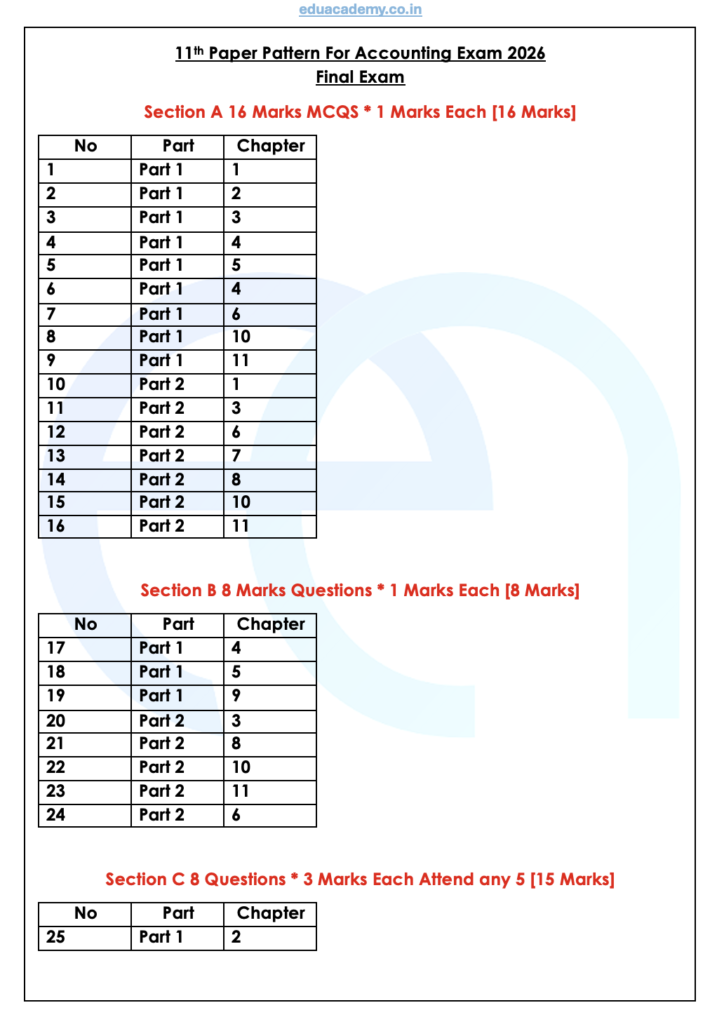
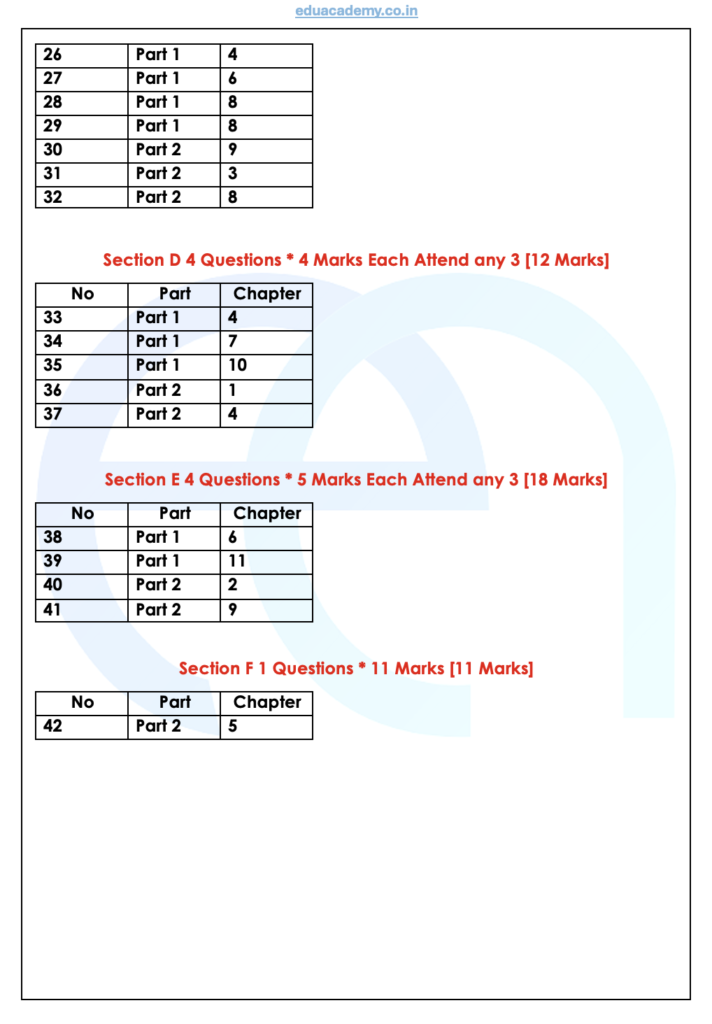
Before you start studying, you need to understand HOW the question paper is structured. The GSEB Class 11 Accountancy exam follows a fixed blueprint every year. Here is what the paper looks like:
Question Type | No. of Questions | Marks Each | Total Marks |
Very Short Answer (VSA) | 8 | 1 | 8 |
Short Answer – I (SAI) | 5 | 3 | 15 |
Short Answer – II (SAII) | 6 | 4 | 24 |
Long Answer – I (LAI) | 3 | 6 | 18 |
Long Answer – II (LAII) | 2 (Choice) | 8 | 15 |
TOTAL | 24 | — | 80 Marks |
Plus 20 marks for Internal Assessment (Project + Practical). Total = 100 Marks.
2. Chapter-Wise Weightage (GSEB 2025-26)
This is the most important section of this blog. Based on the official GSEB blueprint and previous year paper patterns, here is the chapter-wise marks distribution for Class 11 Accountancy:
# | Chapter Name | Marks | Difficulty |
1 | Introduction to Accounting | 3-4 Marks | Easy |
2 | Theory Base of Accounting | 4-6 Marks | Easy-Medium |
3 | Recording of Transactions I & II | 8-10 Marks | Medium |
4 | Trial Balance & Rectification of Errors | 8-10 Marks | Medium-High |
5 | Bank Reconciliation Statement (BRS) | 8 Marks | Medium |
6 | Depreciation, Provisions & Reserves | 8-10 Marks | Medium-High |
7 | Financial Statements of Sole Proprietorship | 12-16 Marks | High |
8 | Accounts from Incomplete Records | 8-10 Marks | High |
9 | Computers in Accounting | 4-6 Marks | Easy |
Pro Tip: Financial Statements, Rectification of Errors, Depreciation, and BRS together carry over 40 marks. If you master just these 4 chapters, you are already halfway to a great score! |
3. Top 7 Most Important Chapters You MUST Prepare
Chapter 1: Financial Statements of Sole Proprietorship
This is the KING chapter of Class 11 Accountancy. Trading Account, Profit & Loss Account, and Balance Sheet — these 3 statements are almost guaranteed to appear as a long-answer question. Adjustments like outstanding expenses, prepaid expenses, depreciation, bad debts, and closing stock are the focus areas.
Must Practice: At least 15-20 full problems with all adjustments.
Chapter 2: Rectification of Errors
This chapter tests your conceptual clarity. One-sided errors, two-sided errors, and errors affecting the trial balance are commonly asked. Suspense Account questions are very popular in long-answer format.
Must Practice: Identifying error types and writing journal entries for rectification.
Chapter 3: Depreciation, Provisions & Reserves
SLM (Straight Line Method) and WDV (Written Down Value Method) — both methods are important. Disposal of assets, change in method, and creating provisions are frequently tested. Expect a 6-8 mark question from this chapter.
Must Practice: Preparing Depreciation Accounts and Asset Disposal problems.
Chapter 4: Bank Reconciliation Statement
BRS is a scoring chapter if you understand the logic. Comparing bank book balance and passbook balance, identifying timing differences, and preparing the BRS are core skills. This usually appears as a 6-8 mark question.
Must Practice: Problems with both favorable and unfavorable balances.
Chapter 5: Recording of Transactions (Journal, Ledger, Cash Book)
Journal entries are tested in VSA and SA questions. Special Purpose Books (Sales Book, Purchase Book, Cash Book with Bank Column) are frequently asked. Posting to Ledger and balancing accounts is also important.
Must Practice: Mixed transactions with GST entries, cash, and credit sales/purchases.
Chapter 6: Trial Balance
Preparation of Trial Balance from given ledger balances is a must-know skill. Errors that affect and do not affect the Trial Balance are theory questions that often come in VSA format.
Chapter 7: Theory Base & Basic Concepts
Accounting concepts (Going Concern, Materiality, Conservatism, etc.), GAAP, and basis of accounting (Cash vs Accrual) are tested in objective and short-answer questions. These are easy marks — never skip them!
4. Types of Questions That Always Come
• Trading Account / P&L Account / Balance Sheet (12-16 marks) — Almost 100% certain
• Rectification of Errors with Suspense Account (6-8 marks) — Very likely
• Depreciation by SLM or WDV method (6-8 marks) — Appears every year
• Bank Reconciliation Statement (6-8 marks) — Highly probable
• Journal Entries / Cash Book / Special Purpose Books (8-10 marks) — Always there
• Accounting Concepts — Theory (3-4 marks) — Easy and guaranteed
• Trial Balance preparation or errors in TB (4-6 marks) — Regular feature
If you prepare all the question types listed above, you are looking at 65-70 marks out of 80 minimum. The remaining marks come from revision and accuracy. |
5. Chapter-Wise Important Topics to Focus On
Financial Statements
• Trading Account with all closing stock adjustments
• Profit & Loss Account with depreciation, outstanding, prepaid items
• Balance Sheet with capital adjustment
• All 12 standard adjustments with their dual effects
Depreciation
• SLM formula and WDV formula
• Change of method (SLM to WDV, WDV to SLM)
• Sale of Asset — with profit or loss on sale
• Provision for Depreciation Account
BRS
• Causes of difference between cash book and passbook
• Starting from both cash book balance and passbook balance
• Cheques issued but not presented, cheques deposited but not cleared
Rectification
• One-sided vs two-sided errors
• Effect on profit — overstated / understated
• Suspense Account preparation
• Before and after rectification entries
6. Last-Minute Revision Strategy (14 Days Before Exam)
Week 1 (Days 1-7): Cover all major chapters — Financial Statements, Depreciation, BRS, Rectification, Journal/Ledger.
1. Day 1-2: Financial Statements — solve 5 full problems daily
2. Day 3: Depreciation — solve SLM, WDV, and disposal problems
3. Day 4: BRS — practice 4-5 problems from both sides
4. Day 5: Rectification of Errors — focus on Suspense Account
5. Day 6: Journal + Ledger + Cash Book
6. Day 7: Full Revision of all the above
Week 2 (Days 8-14): Practice Papers + Theory + Weak Areas.
7. Day 8-9: Solve 2 full previous year papers
8. Day 10: Trial Balance + Accounts from Incomplete Records
9. Day 11: Theory chapters — Concepts, GAAP, Computers in Accounting
10. Day 12-13: Revision of all chapters + formula sheet review
11. Day 14: Light revision only, no new topics
7. Common Mistakes Students Make (And How to Avoid Them)
Mistake 1: Skipping Theory
Many students focus only on numerical problems and ignore theory questions. But 15-20 marks in the paper come from definitions, concepts, and short answers. Always revise theory topics like accounting concepts, GAAP, and bases of accounting.
Mistake 2: Not Checking the Balance Sheet
Students often complete the Trading and P&L accounts perfectly but make small errors in the Balance Sheet — wrong side for assets/liabilities, or missing adjustments. Always double-check that your Balance Sheet balances (both sides equal).
Mistake 3: Ignoring Adjustments in Financial Statements
Adjustments like outstanding salary, prepaid insurance, and bad debts have TWO effects (one in P&L, one in Balance Sheet). Students who learn these dual effects score much better than those who guess.
Mistake 4: Not Attempting Compulsory Questions First
Always attempt the questions you are most confident about first. This helps you manage time better and ensures you do not leave easy marks on the table.
Mistake 5: Poor Presentation
Accountancy is all about neatness. Use ruled lines, write headings clearly, show workings, and present your accounts in the correct format. Examiners award marks for proper presentation.
8. Final Exam Day Tips
• Read the full paper in the first 10-15 minutes before writing anything
• Attempt long-answer questions first while your mind is fresh
• Show all working steps — even partial marks count
• Use proper account formats (T-format or Ledger format as required)
• Write dates clearly in BRS and Depreciation problems
• Leave some time at the end to check your Balance Sheet totals
• Stay calm — if you have revised well, trust your preparation
Conclusion
Class 11 Accountancy is one of the most scoring subjects in commerce if you approach it the right way. The paper pattern is predictable, the important chapters are clear, and with consistent practice you can easily score 70+ out of 80.
The key takeaways from this blog are:
• Master Financial Statements — it is the highest-weightage topic
• Practice Depreciation, BRS, and Rectification thoroughly
• Never skip theory — it is easy marks
• Solve at least 5-6 previous year papers before the exam
• Present your work neatly and show all steps
If you found this blog helpful, please share it with your classmates! And if you want VIDEO explanations of all these chapters, check out our YouTube channel EduacademY — where we have covered the complete paper pattern with 100% guaranteed important questions for 2026! |